Blog

16
Oct

How an incorrect translation of the synod report created chaos

An incorrect translation into English of the original midterm report of the Synod on the Family may have spurred controversial interpretations of the document itself.

The key word “valutando,” which has sparked controversy within the Church, was translated by the Vatican as “valuing.” Italian’s “valutando” in fact means “evaluating,” and in this context would be better translated with “weighing” or “considering.” The English translation, in contrast, suggests a valuing of the homosexual orientation, which could at least create confusion to those who are faithful to the teaching of the Church.

Read more: http://tinyurl.com/pvhdsmz

16
Oct

Unique language translation platform now available in North America

Atlas Real Time is a multilingual publishing system that eliminates the technical work required to create new language versions for websites. The innovative technology can automatically detect changes to any website and initiate translations. The result: websites can be available in new languages in a much shorter time.

Read more: http://tinyurl.com/pr9nnmp

15
Oct

How translators can help stem the ebola crisis

TWBIgnorance about ebola can be as fatal as bodily contact with an infected person. The problem is that most information about how to prevent ebola is not available in the languages understood by the people at risk.

Read more: http://tinyurl.com/lxnzx4o

If you want to help, you can now join Translators Without Borders, a non-profit organization with a mission to increase access to knowledge through humanitarian translations. 

More info about TWB: www.translatorswithoutborders.org

15
Oct

10 grammar mistakes people love to correct (that aren’t actually wrong)

1. Saying “I am good” when someone asks “How are you?”
2. Splitting infinitives.
3. Using “over” instead of “more than” to indicate greater numerical value.
4. Using “preventative” to mean “preventive”.
5. Using “that” instead of “who” as a pronoun to refer to a person.
6. Using words like “slow” and “quick” as adverbs.
7. Ending a sentence with a preposition.
8. Treating “data” as singular instead of plural.
9. Using “they” as a singular pronoun.
10. Starting a sentence with “hopefully”.

Read more: http://tinyurl.com/kmfwrqc

15
Oct

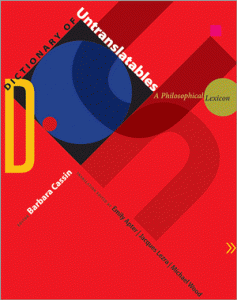
Dictionary of untranslatables – Michael Wood

dictionary of untranslatable

Some words just can’t be translated into another language. Michael Wood, one of the editors of the “Dictionary of Untranslatables,” says that’s just not true — you can translate anything. But even “untranslatable” itself is a word with many meanings.

Read more

14
Oct

Greek literature risks getting lost in translation

imageIf you write in a less well- known language, such as Irish, Finnish or Greek, the essential vehicles for reaching a wider readership are a reliable translator and a publisher who can exploit your book in the marketplace. This in turn requires a cultural policy underpinning the work of translation. But there is no government agency responsible for pushing Greek writers under the noses of commissioning editors, reviewers or the bulk-buying outlets.

In Greece, the Frasis project, managed by the national book centre, funds the translation of books published outside Greece. In its two years of existence, with a budget of €189,000, out of a total of 100 applications it has subsidised the translation of 28 books (at an average cost of €6,500), only four of them into English.

Read more: http://tinyurl.com/p6x2txs

14
Oct

This software reads your emotions via typing style

Can our typing style reveal our emotions? If we believe researchers here, a new computer programme can recognise people’s emotions based on how they type.

An emotionally intelligent online system can change teaching style or the contents of its lectures to better adapt to a particular student’s emotional state, a team of researchers noted.

Read more…

14
Oct

5 verb mistakes

I seen vs. I saw
Incorrect: “I seen the movie last week.”
Correct: “I saw the movie last week.”

2) I been vs. I have been
Incorrect: “I been there!”
Correct: “I have (I’ve) been there!”

3) I done vs. I did
Incorrect: “I done the homework.”
Correct:”I did the homework.”

4) We was vs. we were
Incorrect: “We was just about to start the reading.”
Correct: “We were just about to start the reading.”

5) I would of vs. I would have
Incorrect: “I would of gone with you if I knew.”
Correct:”I would have (would’ve) gone with you if I had known.”

Source: Grammarly

13
Oct

About English pronunciation

Twice as many people speak English as a second language than as a native one! So having the wrong accent means you are actually in the majority and the same can be said for many other world languages.

korean-pronunciation

Read more: http://tinyurl.com/k7aqd95

13
Oct

Confusing ‘jam’ for ‘condom’ while learning French

From being over-familiar to mixing up your homophones, language tutors share their advice on avoiding common faux pas.

Getting led astray by false friends

Read more…